
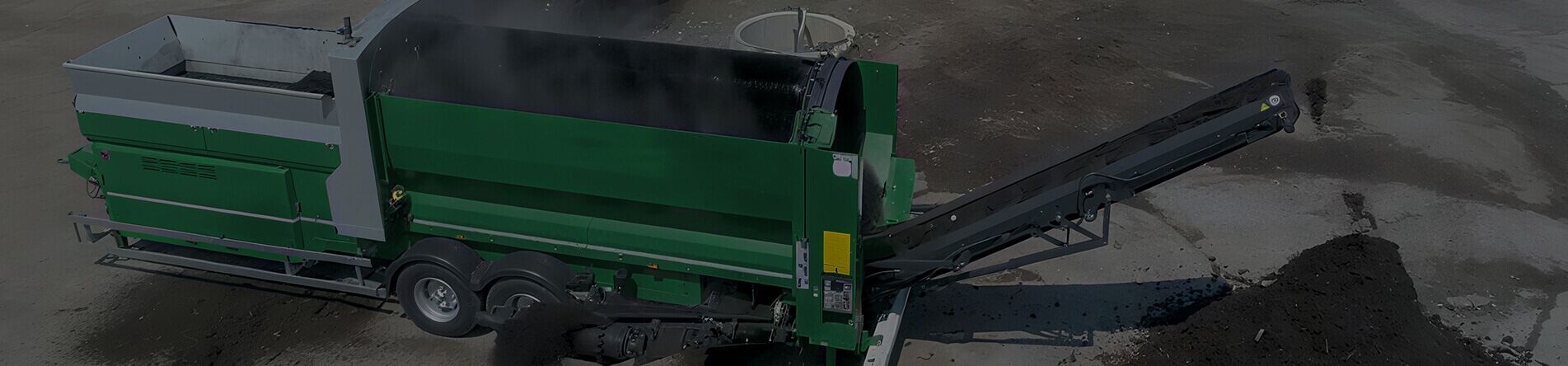
Short answer: the machine had to hit one fixed rate on a site that has no electricity supply. That rate was 60 m³ of soil an hour, held for a full ten-hour shift — about 600 m³ in a day. Power comes from a diesel set, because the yard has no mains. The model chosen was a WTS1230: 1200 mm drum, 3000 mm long, about 9.6 m² of open screen area, three discharge conveyors, towable. Testing was completed at the works, and the unit left Zhengzhou on 30 September 2026.

Soil recyclers tend to arrive with a clear picture of what a bad machine costs them. This one arrived with six answers already worked out:
| Item | What the client specified |
|---|---|
| Feed | Topsoil for landscaping, plus mixed spoil coming back from construction sites |
| Rate | 60 m³/h held as an average, not reached as a peak |
| Shift | Ten working hours, so the daily total lands near 600 m³ |
| Power | No mains connection — diesel generator only |
| Outputs | Three grades separated in a single pass |
| Mobility | The plant follows the stockpile, not the other way round |
Those six lines already point at a model in the middle of our mobile trommel screen range — big enough to sit comfortably at 60 m³/h, small enough to tow behind a standard truck.
Across a ten-hour shift, a headline rate is decided by three things: how much open area the soil crosses, how evenly it arrives, and how long it is allowed to stay. Each was part of this build.
A particle only becomes a product while it is above a hole. Give the material more screen length and more circumference, and it gets more chances before reaching the discharge end. This barrel is 1200 mm across and 3000 mm long, which gives roughly 9.6 m² of screen — against about 4.83 m² on the WTS1022 one size down. The gain is not only volume: fines that would otherwise ride out with the oversize stay in the fine stream, so there is less re-handling afterwards.
A 2290 × 1520 mm mouth is wide enough for a wheeled loader to empty a bucket in one go, and the feeder underneath can be trimmed so the barrel is neither running empty nor drowning. On soil, a plant that misses its rate usually misses it here: the drum was capable, but the material arrived in surges and the mesh never ran at a steady depth.
The drive is variable-speed, which matters more on soil than on most feeds. Dry material wants to move quickly; damp material needs to sit on the mesh a while longer. Slowing the drum is how a wet week is survived without losing the rate — and it is why 60 m³/h is quoted with confidence: this model’s band runs from 30 to 70 m³/h across different feeds, so the project sits in the middle of it rather than at the ceiling. Technical detail lives on the WTS1230 portable trommel screen page.
Where the only supply is a hired diesel set — no substation to fall back on — the electrical design stops being a detail. The set must spin the machine up, hold it at load, and do both without wasting fuel. Three choices on this build serve that:
The second saving off-grid is not electrical at all. Soil processed where it is dug never makes the round trip to a fixed plant. That cuts truck movements for good, and it counts most on a yard far from any supply — which is exactly the situation here.
On a soil site, one pile is rarely enough. Fines go to planting beds or landscaping, a middle grade goes to fill or sub-base, and stone, roots and rubble must exit somewhere. Screening everything together and sorting it later does not delete that work — it pushes it downstream to a loader and a bigger stockpile.
This unit discharges three streams at once: two side conveyors that fold out, plus a tail conveyor. What sets the two cut points is the mesh — interchangeable from 2 mm to 80 mm — and whether the drum carries a single or a double screen. Both were chosen around the client’s own grades, and the conveyors throw material well clear of the frame, so a loader can take a pile without working around steel. The arrangement is detailed on the WTS1230 trommel screen for 3 fractions page.
And when the soil is wet? On a damp site the rate is rarely lost to a weak drive. It is lost to sticky material closing the apertures. Throughput slides from 60 to 30 m³/h with no alarm and no obvious cause. Two things answer it here: a slower drum, which gives damp soil longer on the mesh, and rotating brushes that sweep the holes while the barrel turns. A wet week still slows the plant down; the aim is to keep it producing through that week.
Six hundred cubic metres is simple arithmetic — sixty an hour for ten hours. On site it is a chain, and the trommel is one link:
| Parameter | WTS1230 as built for this project |
|---|---|
| Drum diameter | 1200 mm |
| Drum length | 3000 mm |
| Open screen area | about 9.6 m² |
| Mesh range | 2–80 mm, interchangeable |
| Hopper mouth | 2290 × 1520 mm |
| Rated output | 30–70 m³/h by feed; 60 m³/h is this project’s target |
| Drum drive | variable speed, electrically driven |
| Power supply | client’s diesel set on site — no grid connection |
| Discharge points | 2 folding side conveyors + 1 tail conveyor |
| Fractions per pass | 3 |
| Size when towed | 5855 × 1800 × 2255 mm |
| Mass | about 4200 kg |
The questions below were answered in roughly this order. Each one changed something concrete about the build:
| Question | Answer | What it settled |
|---|---|---|
| What is being screened? | Topsoil plus mixed excavated spoil | Trommel only — no washing or attrition stage needed; mesh and settings carry the variation |
| How much per hour, how many hours? | 60 m³/h; ten hours | WTS1230 rather than WTS1022, with the target sitting mid-band |
| What power is on site? | Diesel set, no mains | The electrical package: one variable-frequency cabinet, soft start, single load |
| Does it stay put? | No | Wheeled towable chassis — 5855 × 1800 × 2255 mm when towed, roughly 4200 kg |
| Where do the three grades go? | Open at the time | Mesh apertures and which conveyor carries which fraction — confirmed before commissioning |
| How wet does it get? | Open at the time | Which mesh to fit first, and where to start with drum speed on damp clay |
The two open items are deliberately resolved before commissioning. Neither alters the machine; both alter what comes out of it — which is exactly the wrong thing to discover on the first working day.
Yes, and it sits comfortably inside the rating. The band runs from 30 to 70 m³/h across different feeds; 60 is a middle figure, not the last few per cent. Soil is also a forgiving feed — no washing, no attrition — so what shifts the number is moisture, aperture and how steadily the hopper is fed.
Two figures decide the rating: how much the machine draws once it is running, and how hard the drum pulls at the moment it starts. Starting is the demanding half, which is why the soft start matters — it trims the surge so the set matches steady draw. The final figure is checked against the delivered unit before it ships.
Damp, sticky soil is the hardest feed a trommel sees, and blinded apertures — not lack of power — are what pull the rate down. The countermeasures here are mechanical: slow the drum to buy residence time, and let the rotating brushes keep the holes clear while it turns.
Yes. Two side conveyors and one tail conveyor work at the same time, giving a fine, a middle and an oversize stream from a single pass — no second machine, no second handling stage.
Mesh is interchangeable between 2 mm and 80 mm. The upper cut on topsoil is normally dictated by the grade the customer has to deliver, so the mesh follows the product specification. A different specification later means swapping screens, not replacing the unit.
On its own wheels: 5855 × 1800 × 2255 mm and approximately 4200 kg in transport configuration, towed behind a standard truck, with the side conveyors folded in for the move.
Machines are built in-house, and support covers repair and spare parts as well as commissioning. For a plant working off-grid in another country, two things are worth agreeing before the order: how quickly wear parts can reach you, and how fast support responds.
Specifications get built around a site, never around a brochure — this order is the proof. Four answers are enough to come back with a proposal that includes model, mesh, generator rating and price:
Smaller volumes are served by the WTS0820 small trommel screen and the WTS1022; larger earthworks programmes go up the range from here. Send the four answers and the recommendation follows.
Every machine is backed by our comprehensive warranty, lifetime online technical guidance, and worldwide spare parts ready to ship.


