
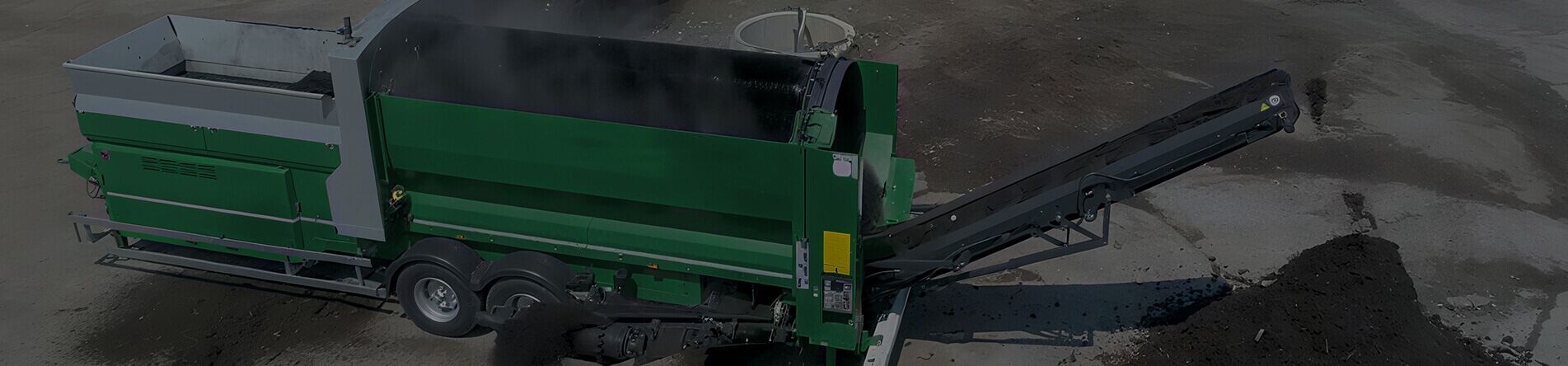
Short answer: on mixed waste, the part that jams a trommel screen is usually not the screen — it is the central shaft. Flexible items such as film, rope and fibre wind around it until the drum stops moving material. The WTS1847 unit shipped to a waste-treatment project in Belarus in May 2026 removes that component altogether: a large-diameter drum with perforated screen plates and internal spiral flights, an open bore with no shaft through the barrel, fines discharged to the sides and coarse material out of the middle of the drum end.
The order came from a client who already knew what their material does to conventional equipment. What follows is the brief they sent, the 33 days it took to move from that first message to a loaded trailer, and the design decisions that came out of it.

The inquiry arrived through the website on 15 April 2026, and it was unusually specific — the client was not shopping for a catalogue model, they were describing a problem:
That brief is what shaped the answer: a shaftless drum, a heavy-duty screen configuration, and an aperture chosen for this material rather than for a generic job.
Nothing in the sequence was exotic — it was simply fast, and ordered. Each stage closed a specific open question instead of reopening the last one.
| Date (2026) | Stage | What happened |
|---|---|---|
| 15 April | Initial contact | Inquiry received through the website: waste-treatment and screening equipment, large processing capacity, anti-wrapping performance. |
| 16 April | First response | Sales and technical team replied within 24 hours and opened a direct communication channel. |
| 20 April | Requirement analysis | Client confirmed the material is waste, complex and prone to wrapping, set out expected production and sorting efficiency, and specified blue as the exterior colour. |
| 25 April | Solution fixed | The WTS1847 shaftless trommel screen was recommended, with a heavy-duty screen configuration and the aperture best suited to this waste stream. |
| 18 May | Shipment | After several rounds of final testing, the unit was loaded and dispatched to the project site in Belarus. |

A conventional trommel screen runs its drum on a central shaft. That shaft is a smooth, continuous, slowly rotating rod sitting in the middle of everything you feed in — which is exactly the geometry that long, flexible items are looking for. Film, rope, wire and textile strips wrap around it within minutes, the wrapped bundle grows, and eventually it interferes with the flow of material inside the drum. The screen plates themselves are usually still fine; the machine simply has to be stopped and cleared by hand.
The WTS1847 uses a shaftless drum structure. There is no central shaft inside the barrel at all, so the material travels through an open bore. Long items have no rotating rod to catch on, and oversized material passes through instead of being held back and tangled. The practical result is fewer unplanned stops, less manual clearing, and lower maintenance cost over a working season — which is the reason this configuration was recommended for a wrapping-prone waste stream rather than a standard drum.
Discharge is arranged so that the two streams never fight each other. Fines drop through the screen plates and are carried away by the side conveyors, while coarse material continues along the drum and exits from the middle of the drum end. Because the coarse fraction leaves from the centre rather than being pushed out against the bottom of the machine, material does not pile up underneath the unit — the working area stays clear and the line keeps running.
A waste site is not a clean, level gravel pad, and the Belarus project is no exception. The unit sits on a mobile chassis so it can be brought into position on uneven ground and moved again when the tipping area changes. The exterior is finished with a corrosion-resistant coating, and the parts that take the hardest wear are reinforced for continuous, high-intensity operation rather than occasional use.
| Item | Detail |
|---|---|
| Application | Waste treatment and screening |
| Material | Mixed waste — complex and prone to wrapping |
| Client requirements | Large processing capacity, efficient sorting, anti-wrapping performance, blue exterior |
| Recommended model | WTS1847 shaftless mobile trommel screen |
| Screen configuration | Heavy-duty screen with the aperture best suited to this material |
| Discharge arrangement | Fines via the side conveyors; coarse material from the middle of the drum end |
| Exterior colour | Blue (client-specified) |
| Shipped | 18 May 2026, from Zhengzhou |
| Support included | Custom production, delivery, installation guidance, commissioning and after-sales service |
The Belarus order moved quickly because the client had already answered most of the questions a supplier would ask. If you are planning a similar project, these are the ones worth having ready:
It means the drum barrel has no central shaft running through it. The drum is driven from the outside, so the inside of the barrel is an open bore with only the screen plates and the internal flights.
Not because the screen openings are wrong, but because flexible items wrap around the central shaft of a conventional drum. Remove the shaft and the wrapping point disappears; oversized material simply travels through.
Thirty-three days from the first website inquiry on 15 April 2026 to dispatch on 18 May 2026 — including requirement analysis, the proposal, and several rounds of final testing before loading.
Yes. This project’s client asked for a blue exterior, and the unit was finished in blue before shipment.
Fines fall through the screen plates and are taken away by the side conveyors; coarse material continues to the end of the drum and exits from the middle. The two streams are discharged at different points, so neither contaminates the other.
Yes — the unit is built on a mobile chassis and is designed to cope with uneven ground, with a corrosion-resistant finish and reinforced components for continuous operation.
Custom production and delivery are followed by installation guidance, commissioning support and after-sales service, so the unit is brought into production on site rather than simply delivered.
Tell us three things — what the material is, what output you need per hour, and what your site looks like — and our engineers will come back with a recommended model, a screen configuration and a quotation. If your material wraps, say so in the first message: it changes the recommendation.
Every machine is backed by our comprehensive warranty, lifetime online technical guidance, and worldwide spare parts ready to ship.


